

Borescope Surveys Explained: See What Is Hidden Without Breaking the Walls
Hidden defects such as slumped insulation, cold bridges or trapped moisture often lead to persistent condensation, mould and heat loss.
A borescope inspection survey allows a qualified surveyor to look inside wall cavities and concealed spaces with very little disruption.
It provides clear evidence of the cause of the problem and the best way to put it right.
TL;DR? Listen to the article.
Why This Matters: The Scale of Damp and Mould in Homes
Problems such as condensation, damp and mould are common in UK homes. According to the English Housing Survey, 29% of households reported at least one of these issues.
Government and public health guidance highlight that damp and mould can lead to significant health problems. Proper investigation and accurate evidence are essential before any remedial work is carried out. Borescope inspection surveys are one of the most reliable ways to identify what is really happening inside the walls.
What Is a Borescope Inspection Survey?
Definition
A borescope is a small camera mounted on a flexible cable that can be inserted through a narrow hole to inspect inside a wall cavity, duct or void. It records still images and video so that a surveyor can see exactly what is going on without removing large sections of material.
How the Survey Works
The process starts with a short consultation to define the scope of inspection. Small holes, usually between 8 and 12 mm, are drilled at agreed locations. The borescope camera is then inserted and the internal cavity is recorded. Once complete, the holes are sealed and the findings are presented in a clear report with annotated photographs.
When a borescope inspection is carried out as part of an energy retrofit assessment, the findings feed directly into the PAS 2035 process. For more information, see our Retrofit Assessments (PAS 2035).
When You Might Need a Borescope Survey
A borescope survey is used when visual inspection alone cannot provide enough information. Below are common reasons why clients request one.
Persistent Damp or Mould
If a patch of mould keeps returning or a wall always feels damp, a borescope can show the true cause.
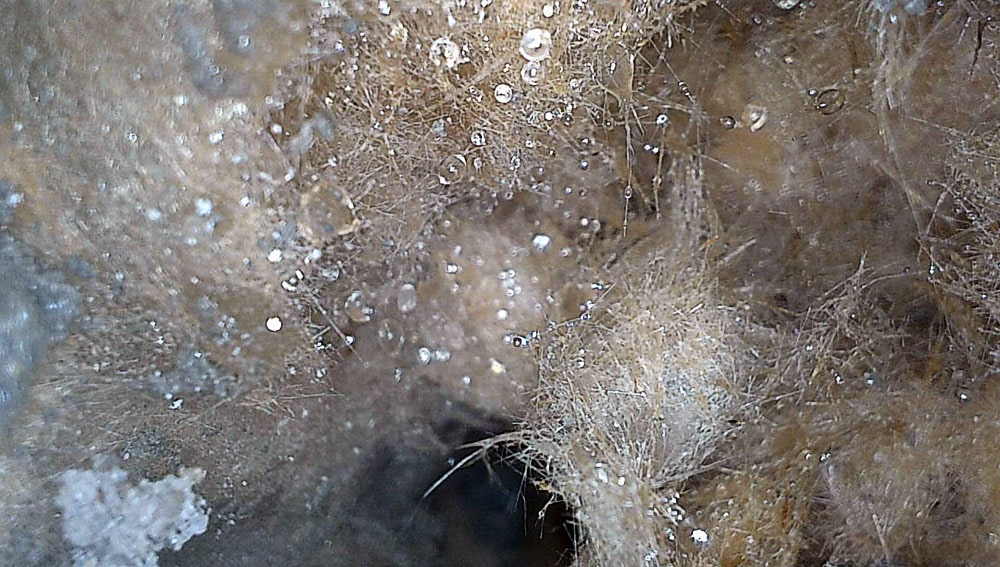
It may reveal leaking pipes, slumped insulation, cold bridges or moisture trapped within the cavity. This helps distinguish between rising damp, penetrating damp and condensation so that the right remedy can be chosen.
Retrofit and Energy Efficiency Projects
Before adding new insulation or upgrading energy systems, PAS 2035 requires an understanding of the existing fabric.
A borescope inspection confirms whether insulation is present and in good condition. It can show if material has slumped or if there are gaps that will reduce performance. This evidence helps prevent retrofit failures and supports applications for funding under schemes such as ECO.
Wall Tie and Structural Checks
In cavity wall buildings, ties can corrode over time. A borescope provides a direct view of their condition without the need for extensive removal of finishes.

Pre-Purchase Building Surveys
Buyers and surveyors sometimes require further evidence of wall or cavity condition before committing to a purchase. A borescope survey provides photographic evidence to help inform the decision.
Conservation and Heritage Work
In listed buildings where fabric loss must be minimal, a borescope allows targeted inspection while preserving original materials.
What Information a Borescope Survey Provides
A borescope survey provides more than a series of photographs. It offers detailed insight into the hidden condition of the building fabric.
Wall and Cavity Composition
The survey can show what the cavity is filled with, whether insulation is continuous or has settled, and if debris or obstructions are present.

Evidence of Moisture or Damage
The camera can reveal damp staining, salt deposits or fungal growth. These signs help identify the cause of damp and guide the correct remedial approach.
Thermal Gaps and Cold Bridges
Missing or slumped insulation creates cold bridges where condensation can form. The borescope helps locate these areas so that insulation can be reinstated correctly.
Hidden Structural Issues
Wall ties, fixings or cracks inside the cavity can be inspected and photographed. This information helps determine whether structural repairs are needed.

Comprehensive Reporting
Harpr Surveyors provide a full report with photographs, commentary and practical advice that clients and contractors can act on.
Typical Applications for Borescope Surveys
Borescope inspections can be applied to many different building types and situations.
Residential Properties
Older homes with cavity walls often experience slumped insulation, cold bridging or damp. A borescope survey helps confirm the cause before any remedial work.
Commercial and Multi-Occupancy Buildings
In larger buildings, service voids and cavities can be difficult to access. A borescope inspection allows safe and accurate investigation of these spaces.
Heritage and Conservation Projects
For historic properties, minimal intervention is essential. A borescope allows inspection of cavities or timber structures without significant damage.
Industrial Applications
Plant rooms, ductwork and pipework can also be inspected with a borescope when direct access is restricted.
How Harpr Surveyors Carry Out Borescope Inspections
Our Process
1. Initial Consultation
We begin with a discussion of the property, its construction and the specific concerns raised by the client.
2. Access Planning
We identify discreet locations for inspection holes, keeping any disruption to a minimum.
3. Inspection and Recording
We insert the borescope, record video and capture images that show the internal condition of the structure.
4. Analysis and Reporting
The images are analysed by an experienced surveyor and combined with any supporting data such as moisture readings or thermal imaging. A detailed report is then produced with clear recommendations.
5. Follow Up
Access points are resealed and, where necessary, we follow up after works or across a season to confirm that the issue has been resolved.
Case Study: St Austell, Cornwall
Background
A homeowner in St Austell, Cornwall applied for an ECO4 grant to improve the energy performance of their property. During the PAS 2035 Retrofit Assessment, we were asked to investigate a recurring mould problem that had been thought to be rising damp.
For more information about available funding options, visit Funding Options for Energy Improvements to Your Home.
Inspection
Small holes were drilled at appropriate heights on all cavity elevations and the borescope was used to inspect the cavity insulation and wall surfaces.
Findings
The survey showed that the blown fibreglass insulation had slumped towards the bottom of the cavity. This created a cold bridge at the lower part of the wall, which led to condensation and mould inside. The problem had been misidentified as rising damp.

Remedial Work
We advised the removal of the old insulation and refilling of the cavity with polystyrene beads as part of the ECO4 works. This reinstated full insulation coverage and removed the cold bridge.
Outcome
When we contacted the homeowner after the next cold season, they confirmed that the wall was dry and free of mould. This case shows how accurate diagnosis through borescope inspection can prevent unnecessary work and achieve lasting results.
Limitations to Consider
A borescope survey can only see what the camera can reach. Some areas may be inaccessible, and the images might not capture every part of a problem. Results are most reliable when combined with moisture readings or thermal imaging. Skilled interpretation is essential to turn camera images into practical advice.
Why Choose Harpr Surveyors
Harpr Surveyors provide practical and evidence-based borescope inspections carried out by experienced professionals. Our service focuses on:
- Minimal disruption to the property
- Accurate, high-quality imagery and analysis
- Clear reporting with practical recommendations
- Integration with PAS 2035 retrofit assessments and ECO4 funding where applicable
If you suspect hidden defects or need evidence to support a funding application, contact Harpr Surveyors to discuss your requirements.
Final thoughts
Borescope inspection surveys are a simple and reliable way to see what is happening inside a wall cavity without causing damage. They reveal the true cause of damp, mould and insulation problems so that repairs can be targeted and cost effective. Harpr Surveyors offer professional borescope inspections as part of retrofit, diagnostic and building survey services. Find out more about our Retrofit Assessments (PAS 2035) or contact us to arrange a survey.


So who do I report this matter too because I’m i a government assistant living and this so call raising damp has lived all on us causing cotton and other disgusting debris matter to bubble outer me a my two lil boys everything this matter has made my life a living not mare
Thanks for reading and commenting on our borescope surveys post.
Have you recently had cavity wall injections with a cotton like insulation and its flowing out of the walls into the property? If so, it sounds like the property wasn’t properly sealed when they did the work. I would highly recommend that you contact your landlord to report the matter.